

Proper preparation determines whether a basket replacement succeeds or introduces new extraction problems.
When it comes to espresso basket type, basket selection depends on dose range, bed depth, and hole pattern matched to the portafilter and grind setup. Precision (non-pressurized) baskets, sized from 14g to 25g, deliver even extraction and clearer flavor compared to standard (pressurized) baskets. Matching basket capacity to actual dose weight prevents shallow beds, channeling, and inconsistent shots across home and café machines alike. Please note – this article does not discuss pod baskets.
Key Takeaways
Espresso baskets accommodate dose ranges from 14g to 25g for optimal extraction ratios.
Filter basket hole size directly impacts water flow and flavor extraction during brewing.
Matching your basket capacity to your coffee roast profile ensures consistent shot quality.
Basket construction falls into six categories—pressurized, precision, ridged, ridgeless, single-wall, and double-wall—each suited to different grind, dose, and skill levels.
Precision baskets use machined, uniformly spaced holes for freshly ground coffee, while standard baskets favor pre-ground coffee with wider tolerance for error.
Ridged baskets help the coffee bed grip the wall to reduce channeling, while ridgeless baskets favor cleaner puck release. Ridged baskets can limit tamping distance and pressure.
Single-wall baskets rely on grind size, dosage, and tamping for resistance, while double-wall (pressurized) baskets add artificial resistance for a beginner-friendly crema.
1st-line Equipment provides replacement baskets and technical support for most espresso machine types.
What Do You Need Before Replacing Your Basket?
Proper preparation determines whether a basket replacement succeeds or introduces new extraction problems. Three categories of readiness matter most: cleaning supplies, measurement tools, and baseline knowledge of basket construction. Skipping any one of these steps risks a poorly seated basket, inconsistent dosing, or a shot that channels water unevenly through the coffee bed.
An espresso basket is the metal filter that sits inside the portafilter and holds the ground coffee during brewing. Its design shapes extraction, flavor clarity, and shot-to-shot consistency. The swap deserves the same care as any other maintenance task on the machine.
What tools are needed before swapping a basket?
Cleaning agents, cleaning tools, and water treatment solutions should be gathered first. Use them to clear residue from the group head and portafilter before fitting the new basket. Old coffee oils interfere with a clean seat. Dosing tools and a reliable weighing scale come next. These confirm both the correct espresso coffee dose and proper basket fit once installed.
What should be measured before buying a replacement?
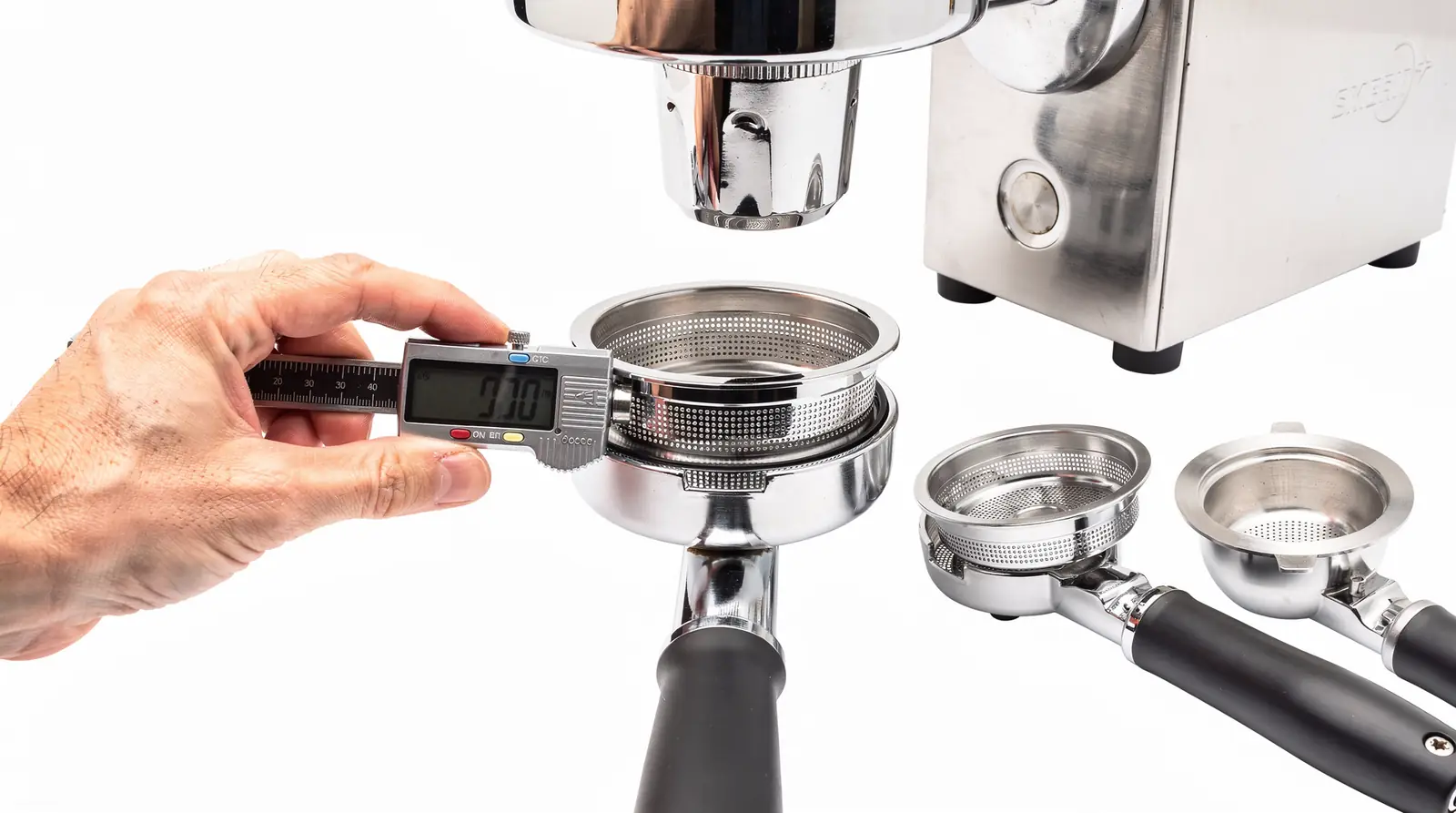
Buyers need three data points before ordering: standard diameter sizes, dose capacities, and the exact dimensions of the current basket. Follow this sequence:
Remove the existing basket and measure its diameter.
Note its rated dose capacity in grams.
Confirm machine compatibility before purchasing.
Skipping measurement invites a mismatch between basket diameter, basket capacity, and the chosen espresso basket type.
How Do You Confirm Basket Diameter And Compatibility?
Confirming fit requires two checks: measuring the basket against the group head, and matching the basket style to the machine’s design. Skipping either step risks a basket that rocks loose in the portafilter or refuses to seat under the group head at all. The basket diameter must match the machine’s group head exactly. Industry standards fall at 51mm, 54mm, or 58mm, and there is no room for approximation between sizes.
Espresso machines vary widely in design, and that variation drives basket compatibility. Dual boiler, heat exchange, manual/lever, single boiler, thermoblock, super automatic, and commercial-grade models each carry different group head specifications. A basket built for one category will not necessarily seat correctly in another, even when the diameters appear close. Compatibility confirmation should always reference the specific model in use, not just the general machine category.
How does group head design affect basket fit?
Group head geometry determines whether a basket locks into the portafilter basket or shifts during tamping and extraction. Home baristas replacing a worn basket should measure the current unit. Cross-reference it against the machine’s documented group head specification via the diagram’s part number before ordering a replacement.
What if the basket size isn’t listed for a machine?
Café operators and equipment buyers setting up commercial installations benefit from direct consultation on compatible espresso coffee machines. Grinders, particularly when confirming basket fit for high-volume or office use. For home units, online technical support and repair services offer a reliable way to verify compatibility before placing an order, reducing the risk of a mismatched purchase.
Steps for confirming fit:
Measure the current basket’s outer and inner diameter with calipers or a ruler.
Identify the machine’s group head classification (51mm, 54mm, or 58mm).
Cross-check the specific model, since dual boiler, heat exchange, and other categories often differ in tolerances.
If the equipment was purchased from 1st-line, contact 1st-line Equipment support for confirmation before ordering, especially for commercial setups.
How Do You Match Basket Capacity And Type?
Matching basket capacity to the correct espresso basket type starts with a simple formula: yield equals dose multiplied by ratio, per guidance on basket selection. That equation determines whether a basket holds too little coffee, too much coffee, or the right amount for a given shot style. Getting this wrong produces channeling, uneven extraction, and wasted espresso coffee grounds.
Follow these steps to pair capacity with the right basket design:
Identify the target ratio, whether a concentrated 1:1 pull or a lighter 1:4 style.
Calculate the required dose using the yield formula above.
Select a basket rated for that dose range, checking manufacturer capacity markings.
Confirm Portafilter Compatibility before purchase, since basket diameter must match the portafilter’s spider recess.
Weigh grounds with a dosing tool or scale to verify actual dose against the basket’s rated capacity.
Adjust grind and distribution if the coffee bed sits noticeably below or above the basket rim.
What’s the difference between tapered and straight-sided baskets?
Basket shape changes water flow through the puck. Tapered baskets narrow toward the bottom and tend to funnel water flow more aggressively through the coffee bed. Straight-sided baskets keep a consistent diameter top to bottom for steadier resistance. Hole pattern and hole size vary between designs too, and both factors influence extraction speed independent of dose.
Does the coffee itself affect capacity matching?
Yes. Pairing a correctly sized basket with freshly roasted coffee supports a tighter dose-to-capacity match. Stale grounds swell and settle unpredictably during the pull. Baristas working with roasted beans benefit from checking freshness alongside basket sizing, rather than treating capacity as the only variable in the equation.
What Are the Different Espresso Basket Types?
Basket construction falls into several overlapping categories: pressurized, precision, ridged, ridgeless, single-wall, and double-wall. Recognizing which category a basket belongs to clarifies how it will handle grind, dose, and pressure before a purchase is made.
Standard baskets ship as stock equipment with most consumer machines. They are sized for pre-ground, supermarket-style coffee and offer wide tolerance for grind and tamp inconsistency, at the cost of flavor clarity.
Precision baskets replace the stock basket with machined, uniformly spaced holes and a dose range built for freshly ground coffee, typically 14g to 25g. They demand accurate dosing and distribution but reward that effort with a cleaner, more even extraction.
Ridged baskets carry horizontal groove along the interior wall. The ridge helps the coffee bed grip the basket’s edge, reducing the risk of water channeling down the wall during extraction.
Ridgeless baskets use a smooth interior wall instead. Removing the ridges limits coffee buildup at the basket’s edge, a detail many precision basket manufacturers favor for consistent puck release and cleanup.
Single-wall (pressurized) baskets hold one perforated wall between the coffee bed and the portafilter spout, letting water pass through the grounds unrestricted. Most precision baskets are single-wall and rely on grind size, not basket design, to control resistance.
Double-wall (pressurized) baskets add a second wall with a narrow interior exit hole. That restriction builds artificial resistance, letting the machine pull a crema-topped shot even from a coarser, pre-ground dose, useful for beginners, but a limiting choice once freshly ground espresso coffee and consistent technique enter the picture.
Matching a basket’s category to the machine, the grind, and the barista’s skill level determines whether these differences show up as a flavor improvement or an added complication.
How Do You Install And Test The Basket?
Correct installation determines whether a test shot proves a well-matched basket or exposes a mismatched one. A basket seated improperly inside the portafilter invites channeling, uneven saturation, and a weak, sour shot the moment water hits the grounds. Skipping a proper test run leaves these problems hidden until an entire batch of espresso coffee goes to waste.
Follow these steps to install and evaluate a new basket:
Remove the old basket by pressing it free from the portafilter rim with a gentle, even push or pull.
Seat the replacement basket squarely, checking that the rim sits flush against the portafilter edge with no gaps.
Dose the fresh basket with ground espresso coffee and distribute evenly before tamping.
Tamp level and firm, using a stable tamper station and a scale to confirm consistent dosing shot after shot.
Lock the portafilter into the group head and start extraction immediately.
Watch the flow for the first ten seconds; even, syrupy streams confirm a properly matched basket, while thin, fast spurts signal channeling.
Log timing and yield, then adjust grind or dose before pulling a second confirming shot.
What Signs Indicate a Basket Is Installed Correctly?
A correctly installed basket produces a steady, cohesive pour with no early blonding or splitting streams. Machines fitted with a shot timer and temperature indicator make this evaluation far easier, since timing and heat data confirm whether the extraction matches expectations.
Who Can Help If Calibration Problems Persist?
Persistent channeling or inconsistent shots after installation often point to a sizing mismatch rather than technique. Online technical support and repair services, including guidance from 1st-line Equipment, assist customers working through calibration questions that surface during testing.
What Mistakes Should You Avoid After Installing?
Three errors undermine even a correctly sized basket after installation: mismatched dosing, neglected cleaning, and rushed budgeting on replacement equipment. Each mistake produces consequences that surface weeks or months later, often mistaken for machine malfunction rather than basket misuse.
Selecting a basket too small for the intended dose creates a shallow coffee bed. A thin bed lowers flow resistance, so water rushes through faster and unpredictably. Shots pull thin, sour, or inconsistent, even when grind size and tamping technique remain unchanged. Matching basket capacity to dose weight prevents this outcome before it starts.
Why does an espresso basket need regular cleaning?
Mineral deposits accumulate inside basket holes with every shot pulled, gradually restricting espresso coffee flow. Skipping routine cleaning with proper agents allows this buildup to clog perforations and shorten the basket’s service life. 1st-line Equipment supplies maintenance products, including cleaning agents, cleaning tools, and water treatment solutions, designed to slow this deterioration.
Is buying a premium basket always the right choice?
Not necessarily. Overlooking discounted options costs buyers real savings. Shoppers who skip sales, clearance and overstock listings, refurbished equipment, and sidewalk sale offers often pay more than necessary for comparable performance.
Avoid these post-installation habits:
Loading a dose that doesn’t match the basket’s rated capacity
Delaying descaling or basket cleaning cycles
Ignoring refurbished or clearance equipment when budgeting for replacements
Assuming all baskets fit every portafilter without checking diameter first
Correcting these habits early protects extraction quality and extends equipment life.
FAQ
What dose range do espresso baskets typically accommodate?
Espresso baskets accommodate dose ranges from 14g to 25g for optimal extraction ratios. Precision, non-pressurized baskets in this range deliver even extraction and clearer flavor compared to stock pressurized baskets.
What standard diameters must a replacement basket match?
The basket diameter must match the machine’s group head exactly, with industry standards set at 51mm, 54mm, or 58mm. There is no room for approximation between these sizes.
What tools should be gathered before replacing a basket?
Gather cleaning agents, cleaning tools, and water treatment solutions to clear residue from the group head and portafilter first. Dosing tools and a weighing scale then confirm correct dose and proper basket fit, all available through 1st-line Equipment.
What’s the difference between a precision basket and a standard basket?
A standard pressurized basket ships as stock equipment sized for pre-ground, supermarket-style coffee and tolerates grind and tamp inconsistency at the cost of flavor clarity. A precision basket replaces it with machined, uniformly spaced holes and a dose range built for freshly ground coffee, typically 14g to 25g, rewarding accurate dosing with cleaner, more even extraction.
Should I choose a ridged, ridgeless, single-wall, or double-wall basket?
Ridged baskets use a horizontal groove to help the coffee bed grip the wall and reduce channeling, while ridgeless baskets use a smooth wall for cleaner puck release. Single-wall baskets rely on grind size alone to control resistance and suit freshly ground espresso coffee, while double-wall (pressurized) baskets add a narrow interior exit hole that builds artificial resistance, useful for beginners working with coarser, pre-ground coffee.
Conclusion
In closing, selecting the correct replacement basket represents a foundational step toward consistent espresso extraction and machine longevity. By matching basket size to your portafilter, verifying material composition, and confirming compatibility with your specific machine type, you establish the technical precision that quality espresso demands. Proper basket selection, paired with routine maintenance and attention to cleaning protocols, ensures your equipment performs at peak capacity for years to come.
