Overview
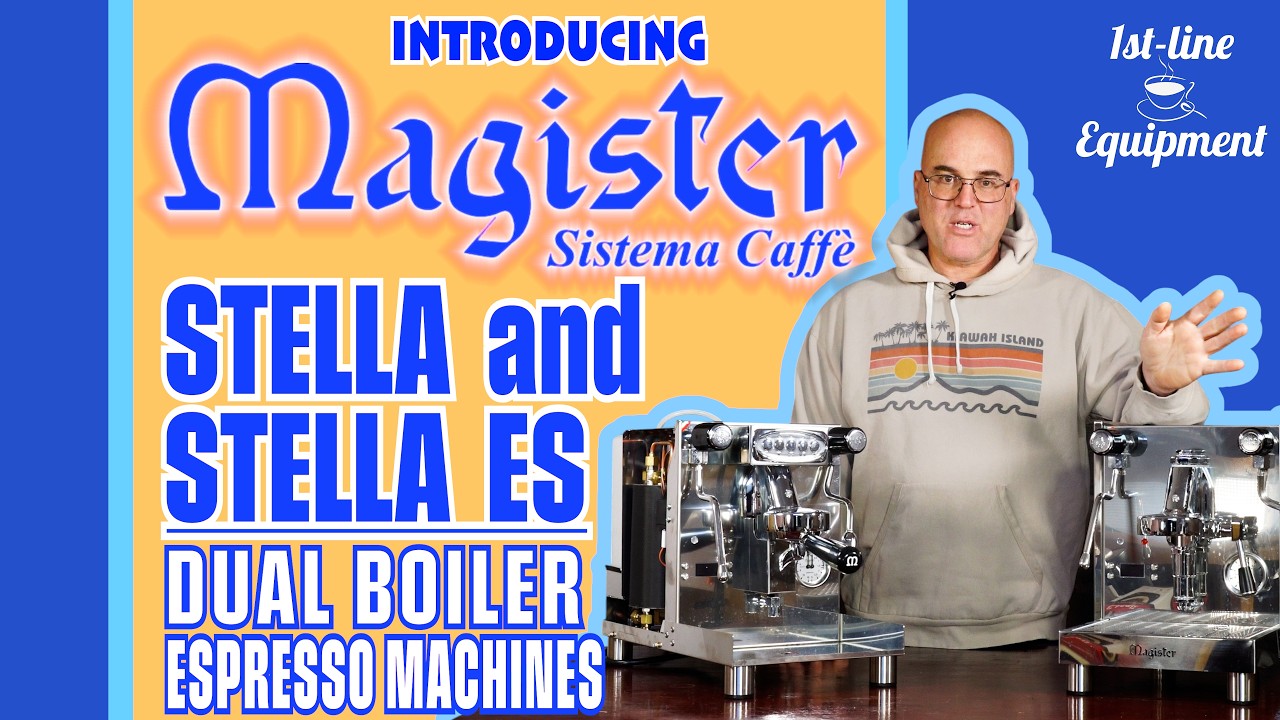
Magister Stella ES Dual Boiler Espresso Machine
The company Magister is relatively new to the espresso industry, starting back in 1997. We started business with them in 2012, bringing in the Stilo line. These were HX machines serviceable in both the home and commercial environments. As our customers became more familiar with the Magister line, the interest in a dual boiler espresso machine started to grow. After years of R&D, they released the Stella line.
Their decision to use copper boilers is one we like.Having a rotary vane pump instead of a vibration pump is always a plus, whether hooking your machine up to a water line or not. The less rattling, the more enjoyable pulling a shot is.
Magister also released a semi-automatic version of the Stella without the electronic touchpad. This gives space above the E61 grouphead to allow for a flow control kit to be installed. However, since the grouphead is lower on the front panel, most of the flow control knobs won’t be able to turn freely.
Videos

Features
Dual Boiler System:
- Copper, insulated: The boilers are made of copper, which retains heat better than stainless steel. Typically, copper boilers are more susceptible to limescale when compared to stainless steel boilers. Therefore, we highly recommend using a water softener. The manufacturer wraps the boiler with insulation for maximum heat retention.
- Pull a shot & steam milk at the same time: Steam is always readily available at the turn of a knob. Hence, there is no wait time going from coffee to steam mode.
- Auto-shutoff: A sensor detects the water level in the boiler. When below the threshold, the heating element shuts off to prevent it from burning out.
Electronic Controls:
- A row of 5 buttons just above the grouphead for pulling your espresso shot. The first four are programmable and the last one is for your manual start/stop shot pulling.
4-Key OLED Display:
- Electronic controls: A set of programmable espresso dispensing options along with a manual start & stop option. For the programmable options, the total amount of water (mL) that it is preset for will show on the display.
- Boiler temperature: Adjust the temperature of both the coffee and steam boilers when active and when in ECO mode.
- Boiler priority: Refers to which boiler refills first when the machine is used. Always use coffee priority to avoid damage to heating element in coffee boiler. If only using the machine for steam and no use of coffee boiler, then set to steam boiler in this scenario only.
- C --> F: Can switch between Celsius and Fahrenheit.
- Shot timer (Chrono function): Visible on display when pulling a shot.
- Counters: Give you a sense how much you use the machine.
- Maintenance schedule: Set for amount of liters of water to recharge water softener or replace water treatment filters for limescale causing agents.
- ECO mode: Machine will go into a low power level mode after a preset time (up to 30 min).
E61 Grouphead:
- Consistent heating: Hot water circulates from the boiler through the grouphead and back to keep the grouphead and your portafilter nice and hot. This keeps the grouphead at a constant, stable temperature compared to other groupheads that have a built-in heating element.
Dual Pressure Gauge:
- Left side measures bar pressure when pulling a shot of espresso.
- Right side measures steam pressure. Optimal pressure is around 1.6 bar.
Cool Touch Steam / Hot Water Wand:
- Rotary knobs: Allows you to control the power of steam / hot water dispensed.
Rotary Vane Pump:
- Quiet operation: Rotary pumps are necessary for direct connect capable machines since vibration pumps cannot handle the incoming water pressure. The main benefit that you will experience is that they are a lot quieter.
Switchable between water tank and direct water connection:
- Large water tank: The larger the tank, the less downtime in refilling.
- Water line connection: Easily switchable through the PID controls. Stainless steel hose & fitting are included.
Parts / Accessories Included:
- Portafilters: Single spout & dual spout. Both 58mm in diameter.
- Filter baskets: 1-cup, 2-cup, and blind for backflushing.
- Tamper: Simple 2-sided plastic.
- Scoop: Simple plastic one for ground coffee.
- Water line connection: Stainless steel braided hose & fitting.
Specifications
| Brand | Magister |
|---|---|
| Height (inches) | 15.25, approximate |
| Width (inches) | 11.75, approximate |
| Depth (inches) | 18.75, approximate |
| Weight (pounds) | 51 |
| Wattage (watts) | 20 amp required, 2020 watts stated on machine |
| Voltage (volts) | 110 – 120 |
| Coffee boiler capacity (liters) | 0.5 |
| Steam boiler capacity (liters) | 1.2 |
| Tank capacity (liters) | 3 |
| Approvals | CE |
- Coffee Boiler Priority Mode (110 Volts): Utilization of 640 watts
- Steam Boiler Priority Mode (110 Volts): Utilization of 1330 watts
- Boiler Priority NONE Mode (110 Volts): Disabled for 110 volt units
Notes
- Flow control capable? This version of the Stella (ES) does have an E61 grouphead, which is flow control capable. However just above the grouphead is the electronic controls. This prevents the installation of any flow control kits, rendering this model NOT flow control capable.
General Espresso Machine Notes/Warnings:
- Upon first use (tank/reservoir models): On the initial start-up (or after a long period of non-use), it is important to make sure the pump is removing water from the tank. When the machine is powered on, you will hear the pump running. After 5 seconds, squeeze the in-line hose in the tank (usually the longest hose, has a particle filter attached). if you hear a different sound, this means the pump is working correctly. If not, immediately power down the machine and contact us. For more information, visit this page General Manual Pump Priming.
- Electrical: To avoid electrical damage to this espresso machine which is not considered a manufacturer's defect, please acquire and install a single-outlet surge suppressor rated at 1080 joules or higher. Without the recommended surge suppressor, the espresso machine can be damaged at the power switch, the electronics, the heating element, the pressurstat, or the wiring inside. For more information, visit this page Power Protection.
- Water: To increase the useful life and not damage your espresso machine, please use softened water. Softened water is water without calcium and magnesium, but still has other minerals for espresso extraction. Do not use distilled, purified, or reverse osmosis water as these types of water create oxidation with the metals and cause the same damaging effects as limescale. For more information, visit this page Water Choice.
- Descaling: We do not recommend descaling unless there is an issue with the espresso machine. Too much descaling can eat away at the metals and gaskets inside an espresso machine. As a preventative measure, we recommend using softened water as explained in the bullet point above.
- Backflushing: This procedure of cleaning the grouphead will need to be performed from time to time. For more information, visit this page Espresso Machine Backflush – Why 50?
Blogs
Support
- Instruction Manual (REV.00)
Parts Diagram
- Parts Diagram (REV.04)
Reviews
Q&A
Ask a question
Please ask follow up questions as a new question. Submitted questions will be first reviewed, answered, and lastly publicized.
-
What are the heating element wattages?
-
A
According to the Stella Dual Technical Data:
- 115 V: coffee boiler 700 W, steam boiler 1200 W
- 220 V: coffee boiler 640 W, steam boiler 1330 W
- 230 V: coffee boiler 700 W, steam boiler 1450 W
- 240 V: coffee boiler 760 W, steam boiler 1580 W
What if the machine shares the circuit with a grinder?
-
Q What if the machine shares the circuit with a grinder? answer nowAsked by on July 9, 2026 3:52 pmA
If the machine and grinder operate on the same circuit and the combined load exceeds the circuit capacity, the breaker may trip. For best results, especially in commercial or heavy-use environments, a dedicated circuit is preferable.
Can the 115 V machine run on a 15 A circuit?
-
A
As stated in the power value shown in the manual, the 115 V version as a maximum total power of 1320 W, which is approximately 11.5 A. Therefore, from a power consumption point of view, it is within a 15 A circuit. However, the installation must still respect the local electrical code, the plug type, the cable rating, grounding, and the rating plate.
Does the espresso machine need a 20 A dedicated circuit?
-
Q Does the espresso machine need a 20 A dedicated circuit? answer nowAsked by on July 9, 2026 3:32 pmA
No. 15 A is enough for the machine itself, but since normal kitchens also serve a grinder, oven, refrigerator, etc. A full kitchen setup of 20 A is best, or a dedicated outlet of 15 A to the machine.
For example, according to the Stella Dual Technical Table:
- 115 V / 60 Hz version: max total 1320 W, about 11.5 A - under 15 A
- 220 V / 60 Hz version: max total 1450 W or 2090 W, depending on configuration - under 15 A
- 230 V / 50 Hz version: max total 1570 W or 2270 W, depending on configuration - under 15 A
- 240 V / 50-60 Hz version: max total 1700 W or 2460 W, depending on configuration - under 15 A
So "20 A" should not be stated as a universal requirement. The correct requirement must always follow the machine rating plate and the local electrical code.
When would steam boiler priority be useful?
-
A
Steam boiler priority can be used for a user who steams a lot of milk and wants faster steam recovery. However for espresso quality and temperature stability, coffee priority is generally preferable.
What is the recommended heating priority?
-
A
We recommend Coffee boiler priority for best espresso temperature stability. This is also the factory preset. For 110V machines, the only options are coffee first or steam first. Both together surpass the amp limitation of most kitchens.
Why are there two different priority menus?
-
A
There are 2 different priority menus because they control two different things.
- The first priority menu controls hydraulic operation: coffee extraction vs steam boiler filling.
- The second priority menu controls electrical heating priority: coffee boiler heating vs steam boiler heating
What is the second priority menu?
-
A The second priority menu is for heating priority between the coffee boiler and the steam/service boiler. The available options are:
- Coffee boiler heating priority
- Steam boiler heating priority
- No priority / simultaneous heating
What is the recommended setting for the first priority menu?
-
Q What is the recommended setting for the first priority menu? answer nowAsked by on July 7, 2026 2:19 pmA
We recommend Coffee Priority. This is also the factory preset. It gives priority to espresso extraction and avoids disturbing the coffee pressure/flow during steam boiler refill.
What is the first priority menu?
-
A
The first priority menu concerns the relationship between coffee extraction and steam/service boiler filling. The available options are:
- Coffee priority - If coffee is being extracted, steam boiler filling is paused or postponed. This protects the espresso extraction from being affected by boiler refill demand. The pressure will drop when another orifice opens up. Coffee priority is the recommended setting for best espresso stability.
- Steam boiler filling priority - If the steam/service boiler is already filling, coffee extractions waits until filling is complete. However if coffee extraction is already in progress, the filling is postponed.
- No Priority / simultaneous - Coffee extraction and steam boiler filling may happen at the same time. This is not recommended. Other than disrupting the coffee extraction, cold water enters the steam boiler which is not likely to heat it immediately due to the heating priority setting, lowering the steam quality.
Why is there no timer-programming menu?
-
Q Why is there no timer-programming menu?Asked by on July 7, 2026 1:55 pmThere are no answers for this question yet. Answer now
Is Crono connected to automatic startup or automatic shutdown?
-
Q Is Crono connected to automatic startup or automatic shutdown? answer nowAsked by on July 6, 2026 1:08 pmA
No. There is no daily or weekly automatic on/off timer described for this function. Crono refers to the coffee extraction timer.
What is “Crono mode”?
-
A
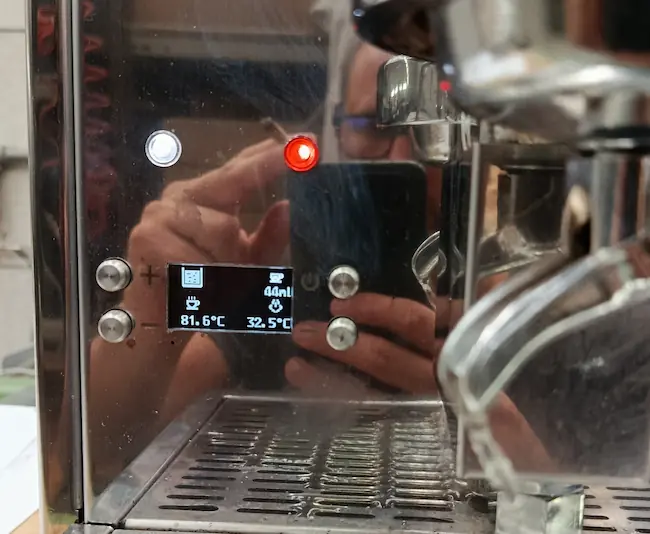
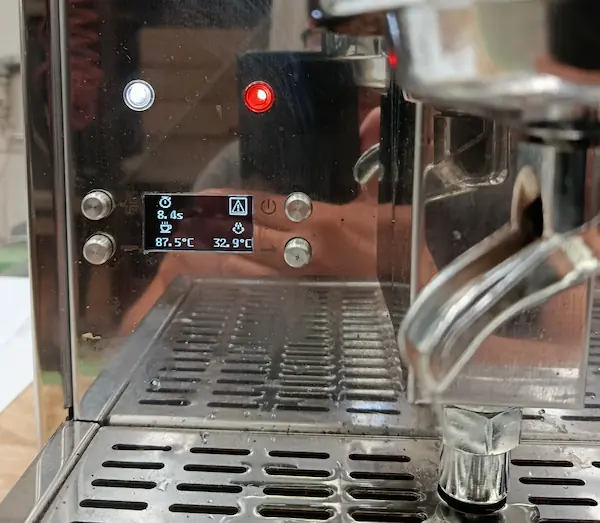
Crono mode is the shot timer / extraction timer display. It is not an automatic on/off timer for the machine. When Crono is enabled, the display shows the extraction time during coffee delivery and keeps it visible for a few seconds after the extraction ends. On the dosed ES version, the display can also show the delivered volume. Here are images without and with Crono: