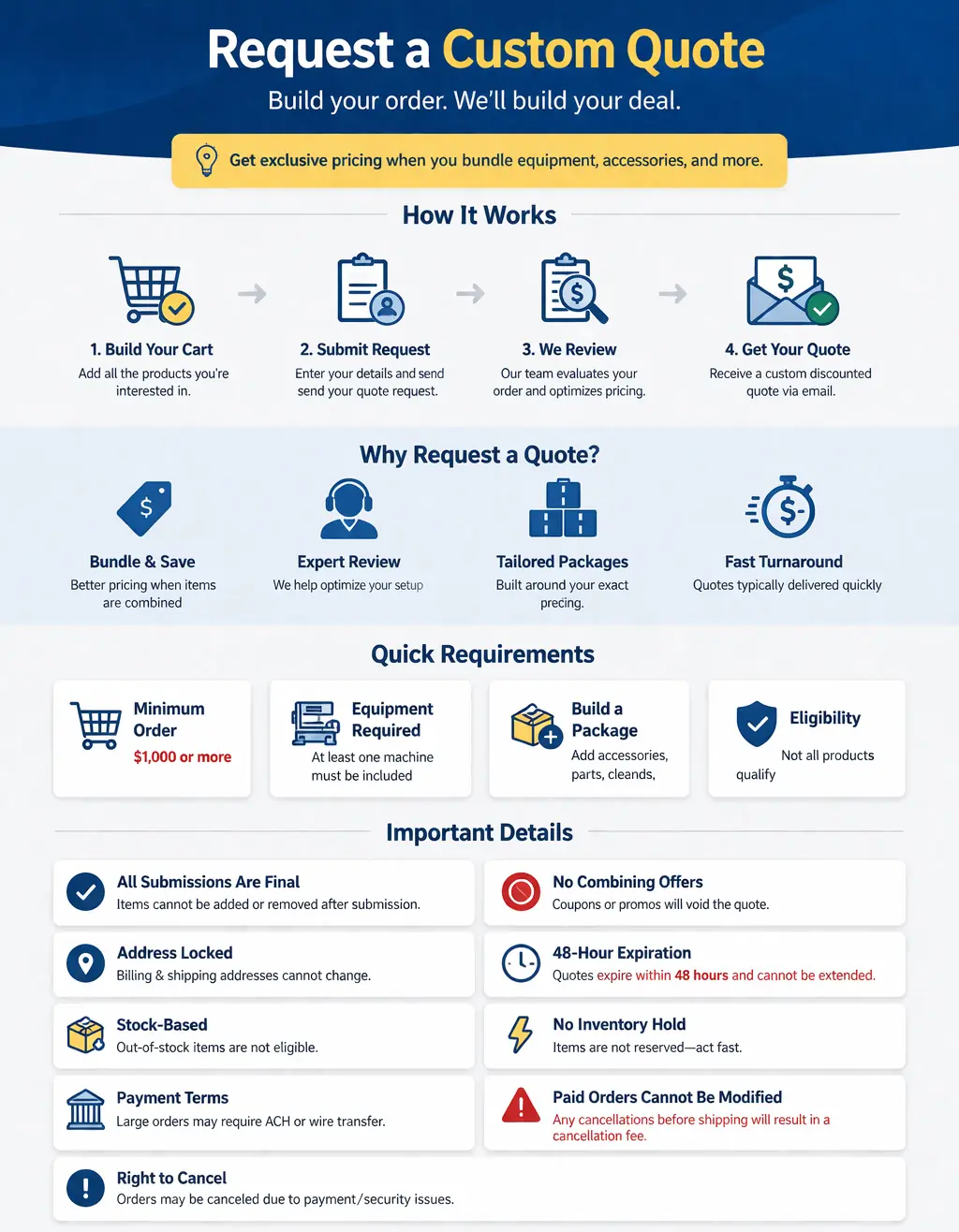
- For more information, please see Terms & Conditions.

Macap Leo 55 Essential Espresso Coffee Grinder
From: $480.00
Espresso grinder featuring 55mm hardened steel flat burrs, stepless micrometric adjustment, programmable timed dosing, touchscreen controls, hands-free portafilter fork, and low-retention design for precise, repeatable grinding.
┌- Terms & Conditions -┐
Commercial Terms & Conditions of Sale
1 year parts & labor warranty limited to manufacturer's defect
- Changing grind settings: It is very important to only change the grind settings when the grinder is on and the burrs are spinning. If not, the burrs will ‘gunk’ up and as a result, will only produce very coarse grinds or none at all. Fixing this will require cleaning (by you) every time this occurs.
- For any issues within your warranty period, please contact us.
Shipping included on orders over $99!
- Standard ground shipping within the contiguous 48 states. Alaska & Hawaii shipping costs extra.
- Total order must be over $99 after all discounts.
- For more information, please see Shipping Included.
Earn up to 3% in EspressoPoints!
- Must be logged into your online account when purchasing to accrue EspressoPoints.
- For more information, please see EspressoPoints.
Frequently Bought Together
Overview
Macap Leo 55 Essential Espresso Coffee Grinder
The Leo 55 Essential is very similar to the Leo 55. The hopper, burr size, & motor are all the same. The only difference is the on-demand controls. For the Leo 55 Essential, all settings and grind operations are controlled by hand. The grind settings on the Leo 55 are controlled by hand and grind operations are controlled by your portafilter. Choosing between the 2 grinders is all a matter of preference.
The Specialità from Eureka is another similar model. They both have 55 mm flat burrs and a similar footprint on your countertop. Both bean hoppers hold approximately 300 grams of roasted coffee beans. However the Specialità has a low profile shape which saves an extra inch off the height. The on-demand controls are simple for both grinders, but the Leo 55 Essential is the one that has a triple dosing option. Combining this with the larger motor & grinding speed makes production a little faster and the clear choice.
Videos
2 videos found

Recipe: 1st-line Kit Kat Pumpkin Pie Latte Celebrating Halloween 2023!
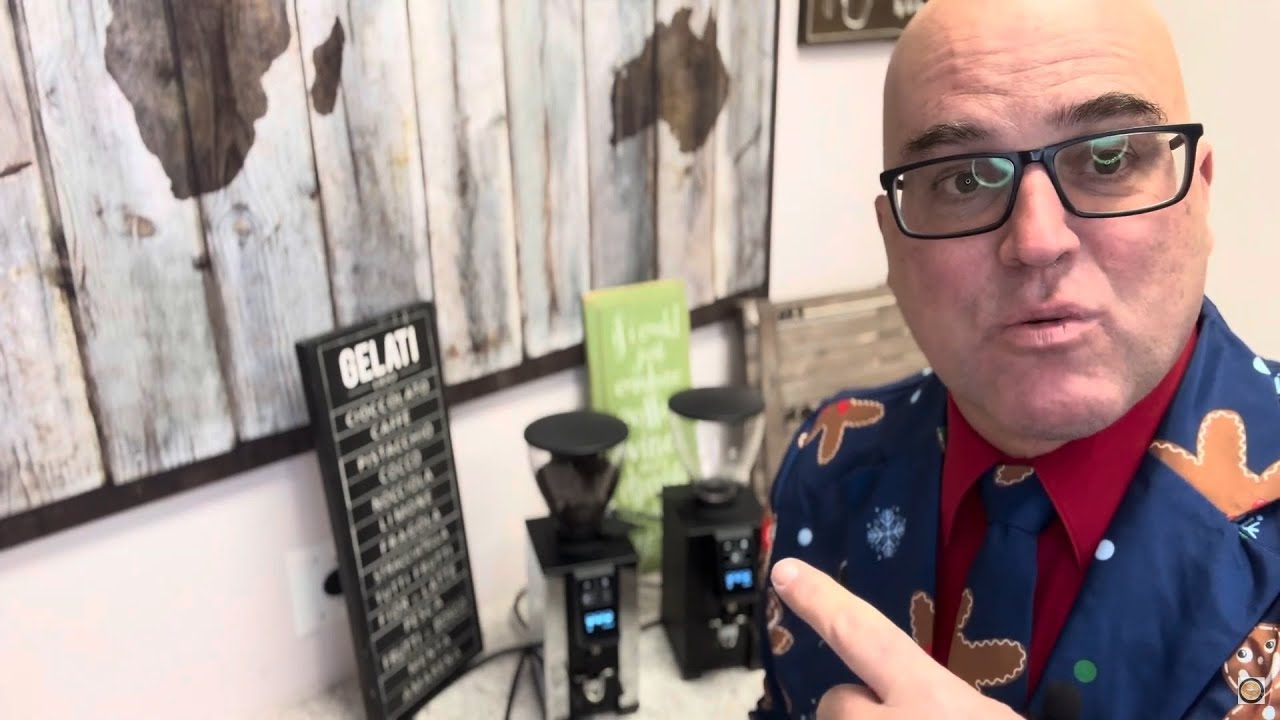
Day 3 Special of 12 Days of Christmas 2023
Features
Grinding adjustment
- Stepless – Gives an infinite number of grind settings which allows you really fine-tune your grind fineness. The adjustment knob is located on the back right of the grinder The entire dial is numbered so you can remember your current grind setting easier. Turn clockwise for a finer grind and counterclockwise for a coarser grind.
- Solid aluminum knob – Built to last over long years of use.


Grinding burrs
- Flat burrs – Large size at 55 mm. The larger the size, the more of a grinding surface, resulting in faster production.
- Easy access – Remove the bean hopper. The 3 center Allen key screws on the top hold the upper burr carrier.
- Very, very little retention in doserless chute.
Portafilter fork
- Ease of use – Allows you to rest your portafilter while grinding for a complete hands-free operation. Accommodates most portafilters.
- Adjustable – There is an Allen key screw that you can adjust to fit your portafilter.
- Removable – You can remove the fork if you wish to grind into a container.
- Rubber coating – The top of the fork has a rubber coating to reduce vibration and prevent scratching the portafilter.


Bean hopper
- Low profile – The total height of the grinder without the hopper is approximately 9.5″. The bean hopper adds another 5.5″ bringing the total height to approximately 15″. The total capacity is approximately 300 grams.
- Stopper – A door near the bottom of the hopper can be pushed in to close the opening. This allows you to remove the hopper with beans inside so you can easily change the beans. There will be some beans already passed in the burrs which will have to be ground out first before removing the hopper.
Electronic controls
- Multiple dosing options – Press the center circular graphic on the screen to switch between single-cup dosing, double-cup dosing, triple dosing (OFF by default), and semi-automatic dosing.
- Time-based grinding – You can adjust the time for each automatic dose from 2.2 seconds up to 30 seconds. You can make very tiny adjustments in 0.1-second increments. You can lock these settings by pressing and holding the circular graphic button for 3 seconds. This helps prevent other users from accidentally changing the dosing times.
- Dosing count – This helps keep track of usage. You can access it by holding the circular graphic for 8 seconds. Once the screen changes, use the “+” and “-” buttons to switch between the options. You also have options to turn triple dosing & semi-automatic dosing ON or OFF.
- Start grinding – The “play” button starts the grinding process.


Easy operation
- Power button – Located in the lower back of the grinder.
- Select grind mode – Simple controls with easy-to-understand display.
- Also quiet operation – ~ 72 +/-3dB (depends upon environment)
Specifications
| Brand | Macap |
|---|---|
| Height (inches) | 15, approximate |
| Width (inches) | 5.25, approximate |
| Depth (inches) | 7.25, approximate |
| Weight (pounds) | 14 |
| Wattage (watts) | 310 |
| Voltage (volts) | 110 – 120 |
| Burr size (mm), Type | 55, flat |
| Hopper capacity (grams) | 300 |
| Approvals | CE |
| Country of manufacture | Italy |
Notes
Espresso Coffee Grinder Warnings:
- Roast Profiles: Espresso grinders sold by 1st-line Equipment, unless specifically indicated on the grinder page, are manufactured for coffee beans that have Italian or espresso roast profiles. Lighter roasted coffee beans may clog the grinder or not grind fine enough. Darker roasted coffee beans, such as French roasted or oily coffee beans, may clog the grinding chamber and/or the grinder chute where the ground coffee exits.
- Changing grind settings: It is very important to only change grind settings when the unit is powered on and the burrs are in motion. If you do not do this, the burrs will ‘gunk’ up and render the grinder to only produce very coarse grinds or no grinds at all. To remedy this, you will have to open up the grinder to get access to the grinding burrs. This issue will be considered operator error for lack of following directions, and not be classified as a defective grinder.
- Electrical cord: For most grinders, the cord is placed between the packaging (foam or cardboard) and the underside body of the grinder. During shipping, it is normal for a bend or insignificant blemish/slice to damage the cord.
- Finding coffee grinds in a new grinder: Most manufacturers test their grinders with coffee beans before they leave their facility. Unfortunately, they are not always able to get every trace of coffee out of the grinders after testing. As a result, you may find coffee beans or grinds inside your grinder, or there may be grinds in the packaging.
- Static issues: There are static issues with all grinders, even the highest-quality models. We firmly believe that the static comes from the coffee beans. If you are having static problems with your coffee grinder, try using a different blend of beans.
- Electrical: To avoid electrical damage (which is not considered a manufacturer's defect), please acquire and install a single-outlet surge suppressor rated at 1080 joules or higher. A surge without protection can damage a grinder at the power switch, the capacitor, the motor, or the wiring.
- Burr cleaning: For routine maintenance of the grinding burrs, we recommend using grinder cleaning agents. We do not recommend any removal of the burrs or the burr carrier for cleaning (unless necessary) as re-assembly can cause damage. If the grinder chamber is dis-assembled, the warranty is voided for any damages that result. It is important to always remove all coffee grinds from the threads of the burr carrier and the grinding chamber.
- Replacing burrs: NEVER use a flat head screwdriver and hammer to wedge UNDER the burrs for removal. This could badly damage your grinder.
Support
Parts Diagram
No block ID is set
Reviews
Leave your review
Q & A
Submit Questions for FAQ
Please review the FAQ to confirm the question or topic was not previously covered.
Any followup questions for FAQ should be requested as a separate FAQ submission.
-
I have one more question regarding the Leo. It relates to adjustable height for the PF. I am using a Silvia PF with a Rocket short funnel. Total height 2 inches max. I was hoping this may be workable? I emailed a picture to customer service showing the measurement/space available.
-
Q I have one more question regarding the Leo. It relates to adjustable height for the PF. I am usin...... Read more answer nowAsked on January 9, 2026 11:56 amA
Sorry for the delay. We made a video which is being edited right now. This video will show the different heights if the fork inserted both ways as well as height without the fork. As soon as we publish it, we will update this post.
I'm very interested in the Leo Essential. Is there a small Macap Hopper available for the Leo?
-
Q I'm very interested in the Leo Essential. Is there a small Macap Hopper available for the Leo? answer nowAsked on January 6, 2026 1:59 pmA
Sorry, at this time, it only comes with the installed hopper.
Will this grinder take a dosing cup such that can grind into the cup.
-
Q Will this grinder take a dosing cup such that can grind into the cup. answer nowAsked on December 10, 2025 8:53 pmA
Unfortunately, we are unable to answer this as different dosing cups have different sizes that may or may not fit on the forks. However, with the forks removed, most dosing cups should fit.
How do we determine proper espresso grind coarseness? We currently have the grind gauge on our Leo 55 adjusted at 1.5, close to its lowest limit. At this setting, 18 grams of ground coffee overflows a portafilter double basket. If we partially fill the basket, tamp with moderate pressure, then add more grounds before tamping again, we can attain this recommended volume by weight. At this point, however, the portafilter is so full that it can't be locked into the group head (of our ACS Minima machine). Reducing the amount of ground coffee works but might explain why consistent crema eludes us. Curiously, we also have similar difficulty reliably producing crema when using E.S.E pods (Caffè Borbone are favorites) with an E.S.E. portafilter.
-
Q How do we determine proper espresso grind coarseness? We currently have the grind gauge on our Le...... Read more answer nowAsked on April 16, 2024 11:42 amA
There are a lot more parameters to making espresso than what you just listed. First, all Italian grinders are not set at 0 for a zero point. The zero point is determined by touching the burrs without coffee until a screeching noise is heard. This is your true zero point. The group head pressure gauge should indicate the resistance created in the filter basket - resistance being fineness of grind, amount of coffee, and the tamping pressure.
Second, the machine group head and portafilter has to be piping hot.
Third, the coffee blend being used has to be an espresso roast or darker. Light roasts may be difficult to achieve crema. Arabica only blends makes it difficult as well. These latter two require a super fine grind.
Fourth, if anyone changed grinder settings while the grinder was not running, then this is only producing coarse grinds. The grinder needs to be cleared of beans, taken to the coarsest setting while running, then brought finer while running with beans being ground.