Overview
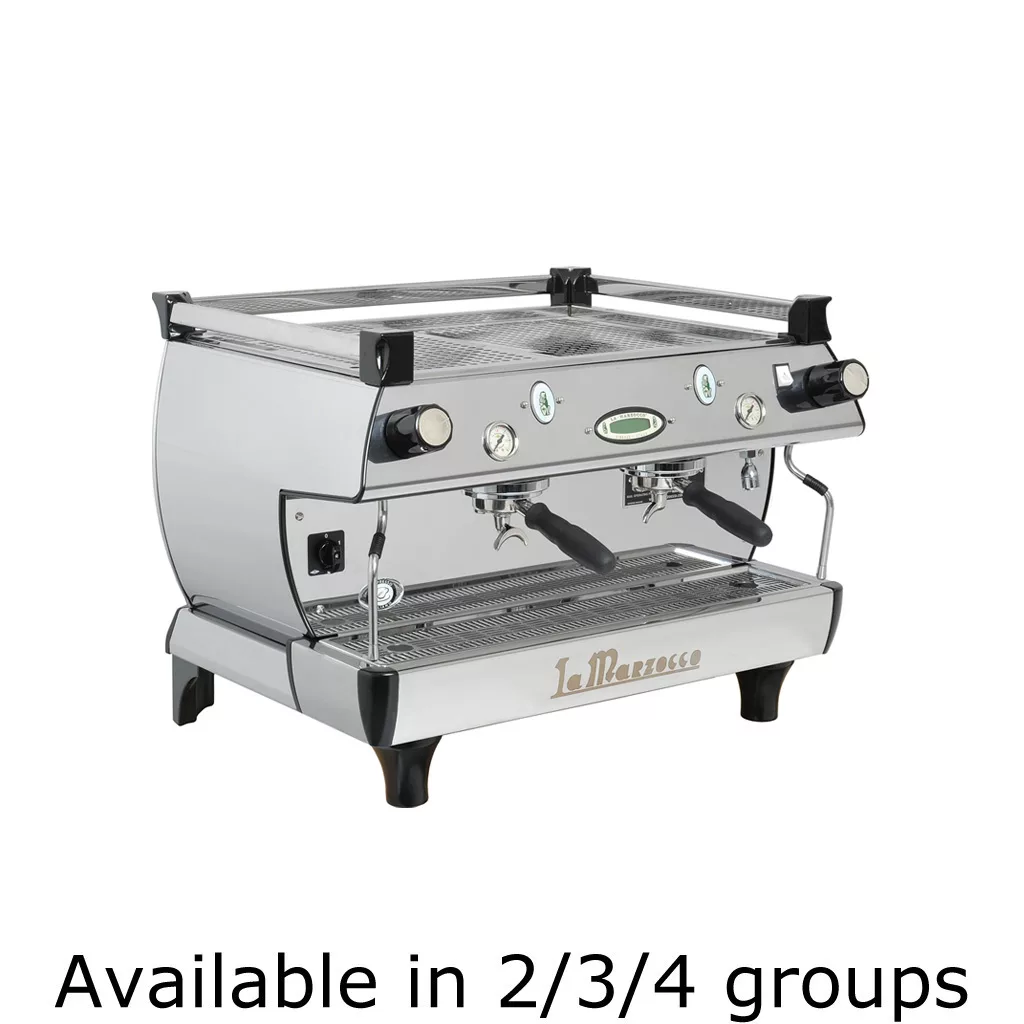
La Marzocco GB5 Semi Automatic Commercial Espresso Machine
The La Marzocco GB5 Semi Automatic was named for Giovanna Bambi, Piero Bambi’s wife. It was designed with the classic La Marzocco styling and spirit. It combines harmonious aesthetics and powerful technological advancements with gracious lines and curves. The GB5 is an understated companion to any coffee bar, while its unmatched temperature stability provides steady brew water and steam even at the peak of the morning rush.
Features
- PID: The PID Controller employs an algorithm to regulate when and for how long the heating element is engaged in the brew boiler. The PID controller allows more efficient and stable regulation of energy. With this level of control, temperature variability is reduced dramatically, making for a more consistent brew temperature. The barista is able to adjust the brew boiler temperature to a precise numerical value using a simple keypad without having to remove machine panels.
- Dual Boilers: Separate boilers optimize espresso brewing and steam production.
- Saturated Groups: Ensure unsurpassed thermal stability, shot after shot.
- Digital Display: Intuitive programming makes it easy to adjust machine parameters.
- Hot Water Economizer: Enables you to fine-tune the tap water temperature for tea.
- Dual PID (coffee and steam): Allows you to electronically control coffee and steam boiler temperature.
- Ruby Flow Restrictors: Ruby flow restrictors resist scale formation and erosion.
- Portafilters & Precision Baskets: Stainless steel portafilters and precision baskets improve your cup quality and consistency.
- Thermal Stability System: As water passes through each element, temperature is further stabilized.
- Tall Cups: Allows you to use the machine with tall, to-go cups (+2.5cm /1in. in height).
- Auto Back-flush Program: Automatic cleaning program.
Specifications
| Brand | La Marzocco |
|---|---|
| Height (inches) | 22, approximate |
| Width (inches) | See below |
| Depth (inches) | 25, approximate |
| Weight (pounds) | See below |
| Wattage (watts) | See below |
| Voltage (volts) | 208 – 240 |
| Boiler capacity (liters) | See below |
| Width inches (cm) |
Weight pounds (kilograms) |
Wattage watts |
Boiler Capacity gallons (liters) |
|
| 2 group | ~30 (77) | ~162 (74) | 4600 | ~1.9 (7) |
| 3 group | ~38 (97) | ~201 (92) | 6100 | ~3.0 (11) |
| 4 group | ~47 (120) | ~280 (128) | 8000 | ~3.9 (14.5) |
Notes
- This product will be drop shipped from the manufacturer.
General Espresso Machine Notes/Warnings:
- Upon first use (tank/reservoir models): On the initial start-up (or after a long period of non-use), it is important to make sure the pump is removing water from the tank. When the machine is powered on, you will hear the pump running. After 5 seconds, squeeze the in-line hose in the tank (usually the longest hose, has a particle filter attached). if you hear a different sound, this means the pump is working correctly. If not, immediately power down the machine and contact us. For more information, visit this page General Manual Pump Priming.
- Electrical: To avoid electrical damage to this espresso machine which is not considered a manufacturer's defect, please acquire and install a single-outlet surge suppressor rated at 1080 joules or higher. Without the recommended surge suppressor, the espresso machine can be damaged at the power switch, the electronics, the heating element, the pressurstat, or the wiring inside. For more information, visit this page Power Protection.
- Water: To increase the useful life and not damage your espresso machine, please use softened water. Softened water is water without calcium and magnesium, but still has other minerals for espresso extraction. Do not use distilled, purified, or reverse osmosis water as these types of water create oxidation with the metals and cause the same damaging effects as limescale. For more information, visit this page Water Choice.
- Descaling: We do not recommend descaling unless there is an issue with the espresso machine. Too much descaling can eat away at the metals and gaskets inside an espresso machine. As a preventative measure, we recommend using softened water as explained in the bullet point above.
- Backflushing: This procedure of cleaning the grouphead will need to be performed from time to time. For more information, visit this page Espresso Machine Backflush – Why 50?
Q&A
Ask a question
Please ask follow up questions as a new question. Submitted questions will be first reviewed, answered, and lastly publicized.
There are no questions yet. Be the first to ask a question about this product.
Reviews
There are no reviews yet.