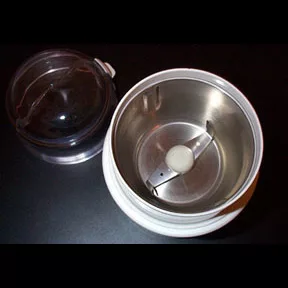
Ever wonder why coffee shops produce higher quality beverages than in your home? Here is one of the reasons. The benefits of a burr grinder over other blade-type grinder are quite noticeable to the espresso enthusiast!
Comparing Blades vs Burrs
Burr grinders can produce more consistent and precise grinds. Blade grinders produce grinds inconsistent in shape and size. Also, blade grinders produce and place more heat onto the grinds than a burr grinder. What does all this mean? To produce flavorful espresso-based beverages, grinds consistent in shape and size must be used so that that water can evenly and equally extract the flavor out of the grind. Grinds inconsistent in size and shape will be extracted inconsistently; Therefore, they will produce a cup flavored with bitterness and/or with a very weak flavor. With respect to heat, the heat usually produces a more bitter or burnt flavor in the cup.
Shopping for burr grinders
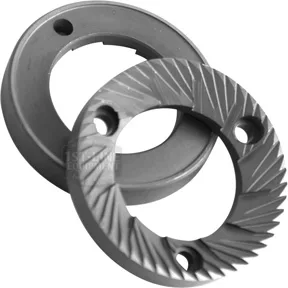
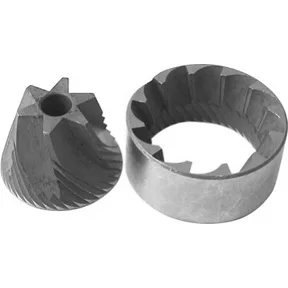
There have been new introductions of burr grinders. Those selling under $100 usually have smaller burrs that sometimes produce a slightly inconsistent grind. Since these burrs are much smaller, they tend to overheat which negatively affects the grinds. Although we sell some sub-$100 grinders, you would only purchase one if there is very minimal demand for coffee beverages (say, one cup/pot/espresso pull per day). This is why some manufacturers have integrated “conical burrs.” These burrs are typically larger than the smaller ones found on grinders under $100. Conical burrs do perform well since they grind more consistently and the shape (like a cone head) dissipates the heat rather well. We also stock hand-cranked coffee grinders that have conical burrs. Although they can take forever (well, seems like forever when grinding for 5 minutes), the hand-cranked coffee grinders achieve a consistent grind without any heat built-up (except for the blood and sweat created in cranking the lever). : ) The more expensive coffee grinders ($200 and up) primarily use flat burrs. The reason is that the burrs on these units are much larger than that found on the sub-$100 grinders. The flat burrs tend to grind very fine (getting as close to Turkish grind – very fine powder of coffee) and they have very powerful motors.