
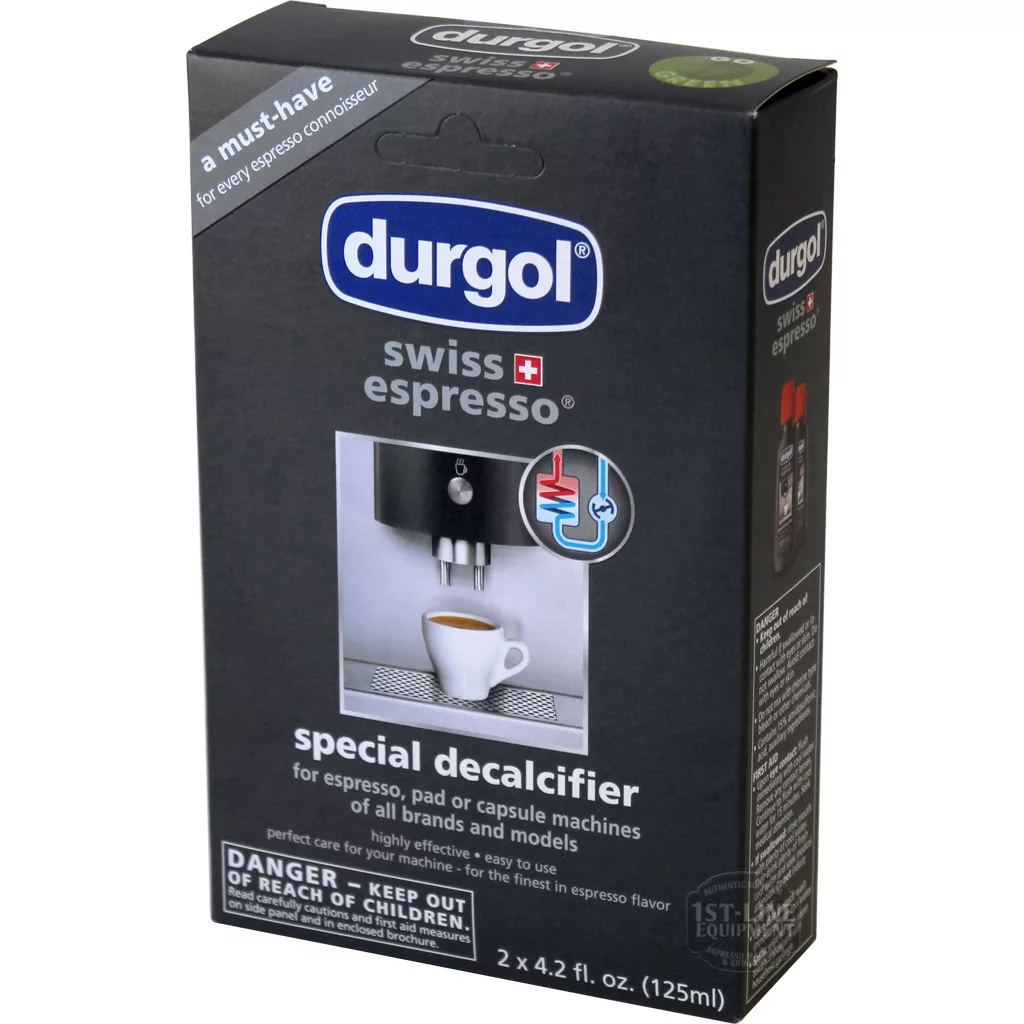
DISCONTINUED Durgol Swiss Espresso Special Decalcifier Liquid – 2 4.2 oz bottles
$0.00
Please visit one of the links below for more comparable products.
Overview:
Made in Switzerland, Durgol can be utilized in decalcifying a variety of household products: coffee makers, pots, pans, humidifiers, crystal vases, flower and plant drip trays, dishwashers, shower heads, faucet screens, nozzles, immersion heaters, and chrome plated items, such as steel sinks, faucets, iron surfaces, and indoor fountains. Sold in sets of two (2) 4.2/125ml ounce bottles.Durgol Swiss Espresso is a special decalcifier which decalcifies all types and brands of espresso machines at the highest level of quality. We were blown away by a demonstration of Durgol at a recent trade show. Compared to vinegar and competing descaling solutions, Durgol was far more efficient and effective at removing scale build up. Durgol Decalcifying Liquid is also recommended by Capresso for many Capresso Coffee/Espresso Machines (check your manual for recommendations). Not just for cleaning and decalcifying coffee makers – also ideal for electic hot water/tea kettles, irons, pots and pans, chrome plated sinks, faucets and shower heads. New packaging includes two 125 ml single use bottles in a box.
Features:
- It is a special decalcifier for quality espresso machines of all brands, including fully automatic machines, half automatic machines, manual machines and coffee pod machines. Filter machines, electric water heaters and tea kettles can also be decalcified.
- It is highly effective, easy and safe to use and is guaranteed to decalcify quickly and easily without the need to wait for the decalcification process to work. Regular use of this special formula will ensure the optimal quality of your espresso and extend the life span of your machine. It leaves no residue and after decalcification and rinsing, your machine is completely safe for use.
- It is available in a package which contains two single-portion bottles of 4.2fl.oz./125ml each. One single-portion bottle is designed to decalcify one machine once.
- It is highly effective but at the same time gentle to your machine.
- It works 5-10 times faster than other branded decalcifiers. There is no need to interrupt the decalcification process to wait for it to work.
- One single-portion bottle (4.2fl.oz./125ml) can dissolve up to 0.35oz./10g of lime. This is sufficient to decalcify one espresso machine once.
- Because of its special corrosion protection formula, it will not damage your espresso machine when used correctly. No residue that could clog your machine will develop during decalcification.
- It comes ready to use. In contrast with powder or tablet decalcifiers, it is not necessary to dissolve in water. It doesn’t contain any additives, such as those found in tablets, which can clog your machine.
- One single-portion bottle (4.2fl.oz./125ml) provides a complete decalcification for your machine. Other decalcifiers are often under-dosed and therefore do not completely decalcify your machine.
- It leaves no chemical residue after decalcification and rinsing. It is odorless and leaves no taste.
- During the reaction of acid with lime, the acid is neutralized via the formation of salts. The presence of unused durgol in waste water contributes to the neutralization of lye which is present in the water from detergents. It does not fertilize the water.
- Because of its strong lime-dissolving ability, it can be dosed economically and in an environmentally-friendly way. The single-use portions prevent overdosing.
- The bottle is made of PET and is therefore environmentally compatible and recyclable.
- NOTE: Please follow the instructions included with your equipment before using the instructions on the packaging of this cleaner. If there are no instructions by the manufacturer, please contact the manufacturer directly. Please keep in mind that descaling an espresso machine can cause leakage at components that were damaged by limescale. 1st-line Equipment is not responsible for any loss, incidental or consequential damages from the use of this item.
“
Ask a question
Please ask follow up questions as a new question. Submitted questions will be first reviewed, answered, and lastly publicized.
-
I was wondering if this would work to descale my Lelit Mara X:
The instructions included say to mix it at a 1:1 ratio or in special cases mix it to make 1L worth of solution.
According to this guide: https://www.1st-line.com/technical-support/general-maintenance/descaling-instructions-heat-exchanger/
I need enough to fill up the water reservoir(2.6L). Would this product work if I mixed both bottles to make 2L or should I try to find a different solution to descale my machine?
-
Q I was wondering if this would work to descale my Lelit Mara X: The instructions included say to m...... Read more answer nowAsked by Max on March 1, 2021 8:13 pmAnswered by the admin
Durgol is a light descaler and can be used without the softener attached. We normally do not recommend a descaler unless there are issues. The reason is that descalers can eat away at the metals.