
Heat Exchange (HX) vs Dual Boiler (DB) Espresso Machines: A common myth for newcomers to the espresso machine community is that one needs a dual boiler espresso machine to extract espresso and steam / froth milk simultaneously. This myth is false. The following machines can extract espresso and steam milk at the same time:
- Heat exchange espresso machines.
- Dual boiler espresso machines (independent coffee boiler and independent steam boiler).
- Espresso machines with an independent coffee boiler and independent steam thermoblock.
We have worked on two generic visual representations, one HX model vs one DB model.
Overview of HX vs DB Espresso Machines
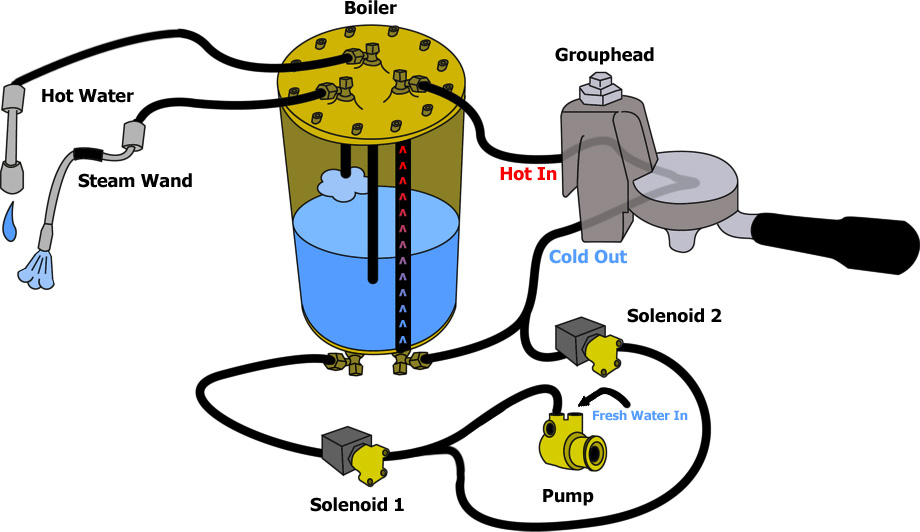
Immediately below is a visual representation of the HX design with a thermosyphon grouphead. The heat transfers between the steam / hot water in the boiler and the closed tube that passes through the boiler.
In the first diagram, the HX tube is the larger tube inside the single boiler with upside down ‘V’s. This tube flash heats the water to make espresso. Incoming cold water mixes with this hot water when the extraction starts. When not extracting espresso, this same water inside the closed loop system heats up in the heat exchanger. Then the water pushes through to the grouphead, which forces the cooler water back to the boiler for re-heating. If your espresso machine has a brew pressure gauge, you will see fluctuation while the machine is idle. This is why you should not read the brew pressure gauge while the machine is idle.
In some cases, the larger boiler is horizontal, and the heat exchange tube remains vertical. In other cases, the horizontal boiler incorporates a horizontal tube from inside to another. For most vertical boilers, the heating element is at the bottom of the boiler. At times, the heating element is on top of the vertical boiler with internal extensions to keep it under water. We have never seen a vertical boiler with a heating element on the side. On horizontal boilers, the heating element is usually on the side.
In some cases, there are no thermosyphon tubes into the grouphead. There is on one tube running to the grouphead. This grouphead is usually attached directly/welded to the boiler for passive heating by way of the metal.
Immediately below is a visual representation of the dual boiler design with a thermosyphon grouphead.

Espresso quality in the cup
The dual boiler espresso machine model has superior control over its heat exchange counterpart in the temperature control of the water in the boiler. This better temperature control allows you to change the boiler water temperature to match better with your coffee blend. The superior temperature control offers a better extraction in the quality found in the cup. Therefore, the dual boiler espresso machine model with PID controls is a better choice for espresso-only consumption. Our favorite is the Torre Peppina EVO Premium, which also features manual control over the brew pressure to create different flavor profiles! We also love the Bellezza Bellona since you can program the infusion time!
There has been discussion that the coffee boiler size on a dual boiler espresso machine model determines the espresso quality in the cup. The main point is that a smaller boiler will turnover water faster, and this fresh water makes superior espresso. Although we were a believer in this before we carried DB espresso machines, we no longer believe this holds true. Our reasoning is that if this were true, then a HX machine with a much smaller capacity would make extract superior espresso over a DB machine.
Steaming capacity for HX vs DB espresso machines
From our observations, the HX model is a more powerful steamer than its DB counterpart. If you are frothing or steaming milk for milk-based espresso beverages, then the heat exchange model is superior as the heat exchange model seems to have more steaming power and more steaming capacity than its dual boiler counterpart. The reasons are:
- that the higher steaming performance of the heat exchange system design will allow for quicker turnover in producing cappuccino and latte drinks, and
- that the espresso quality is not ‘that’ important as the milk in the drink dilutes the espresso and the difference in the quality of the cup (milk and espresso) is very insignificant.
Warm up time for HX vs DB espresso machines
An example of a brand that carries both heat exchange espresso machines and dual boiler espresso machines is VBM. The VBM heat exchange models, including the Domobar Super Analogic HX and Junior Digital HX, take about 20-30 minutes to warm up. The VBM dual boiler models, including the Super Digital DUAL PROFILER and Super Electronic DUAL PROFILER, takes about 30-45 minutes to warm up both boilers. You can place our VBM espresso machines on a timer. However, you must plug in the wall outlet first, then the surge suppressor (1080 joules or higher), and then your espresso machine.
Energy savings for HX vs DB espresso machines
The DB model allows you to independently turn on/off the coffee boiler or steam boiler. If you only use the coffee boiler, electrical usage is only 600 watts for the coffee boiler heating element. The HX model only has an power switch for the whole machine.
Delta (difference or offset) between boiler water temperature and grouphead water temperature
On average, the delta of the PID programmed temperature and the grouphead water temperature is ~20 °F. However, we have done a lot of testing with PID dual boiler machines in several different environments. In our opinion, we can say in with good certainty the following:
- An offset is most likely to be different from environment to another.
- The offset can change even with the machine in the same environment, but one of the variables change. Environments include variables such as ambient temperature, drafts, actual voltage to machine, etc. For example, we tested a PID machine in a basement – one area where there was no draft, and another area where there was a draft. The offset was different by as mush as 5 degrees. We tested a PID machine with a room temperature of 76 °F and then again with a room temp of 66 °F. Again, a different difference in the offset.
- The offset can change if the PID sensor has limescale build up – if the PID sensor in the boiler has limescale buildup (and they have a higher probability to do so on PID dual boiler espresso machines), and we have seen up to a 40 °F difference between the grouphead water and the programmed temperature. Although some manufacturers use the offset as a selling point, it can literally drive one nuts as this becomes a false pretense. In our opinion, it is best to use the average of 20 when initially programming the machine, and the best way to determine your optimum taste is to change the programmed temp based on the taste in the cup leaving all other parameters is the espresso extraction process being equal – just like one would only change grind settings with all other things being equal. This is really the best way to get the machine to the right temp for your coffee bean / blend. This is why we do not believe that offset programmability is an important factor for PID machines at this time.
Thank you for reading about heat exchange espresso machines vs dual boiler espresso machines! Have any questions or are you interested in purchasing a heat exchange espresso machine or dual boiler espresso machine? Then feel free to contact us via phone or send an email using the Contact Us link!
Want to Learn More?
Please note the above information is subject to copyright. It cannot be published by any means without the expressed written consent of 1st-line Equipment, LLC.